The Only Question That Matters for Your B2B Positioning
Are you helping your customer make money, or save money?
It sounds reductive. In a B2B world obsessed with "Category Creation" and "Strategic Partnerships," we often over-intellectualize our value. But for 90% of products, the foundation of your survival rests on one of those two pillars.
If you can’t point to a line item on a P&L statement, you don’t have a value proposition. You have a hobby.
The Positioning Stack
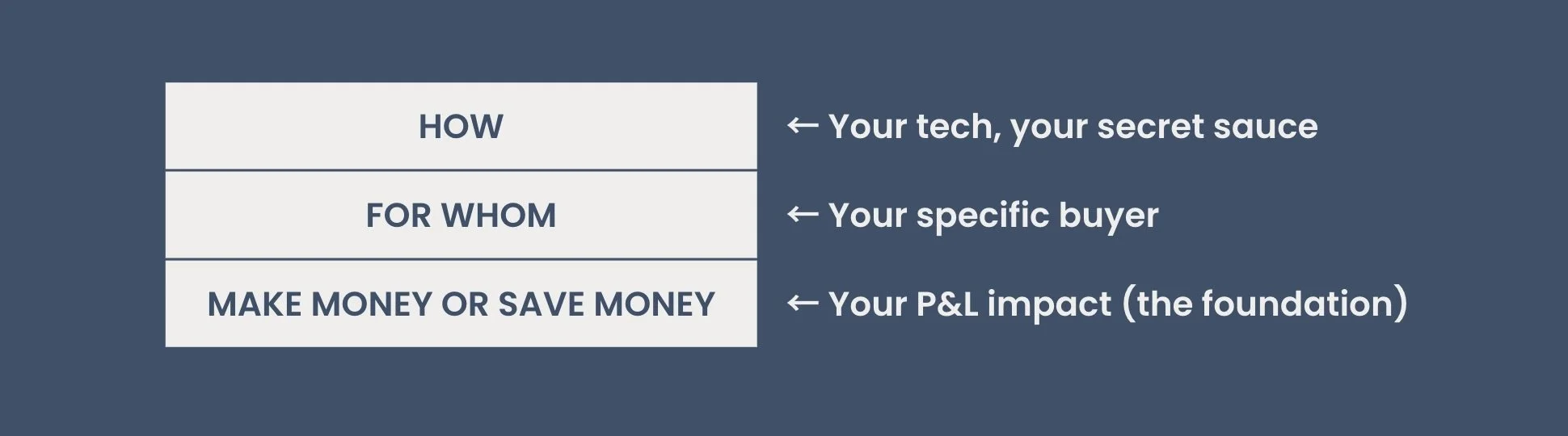
B2B Positioning Stack
Most teams build their positioning upside down. They start with the "Secret Sauce" and work their way down to a buyer. To win, you have to flip the stack:
P&L Impact (The Foundation): Do you increase the top line or protect the bottom line?
The "For Whom": Who is the specific human whose bonus depends on that P&L impact?
The "How": What is the unique technical approach that makes this possible now?
Layer 1: The P&L Impact
"We help companies grow" is fluff. "We help semiconductor fabs reduce yield loss by 8-12%" is a business case. If a CFO can't categorize your invoice in 3 seconds, your deal will stall in procurement.
Layer 2: The "For Whom"
Specificity is your best marketing tool. "Manufacturing companies" is a black hole. "Process engineers at Tier 1 automotive suppliers struggling with 20% scrap rates" is a target. You don't find this through a brainstorming session; you find it through 30 discovery calls where you listen for the pain in their voice.
Layer 3: The "How"
In Deep Tech, your "How" is your moat. But you only earn the right to talk about your proprietary physics or AI architecture after you’ve proven you understand the buyer’s P&L. The "How" is the proof, not the lead.
The 60-Second Positioning Audit
Run your current homepage through these filters:
The CFO Question: If a CFO asked, "Which line item does this hit?", does your headline answer it?
The 10-Second Test: Strip out the words "Scalable," "AI-powered," and "Seamless." Is there anything left?
The Competitor Swap: If you put your "Value Prop" on your biggest competitor’s slide deck, would it still "sort of" work? If yes, you aren’t differentiated enough.
The 90-Day Bet: If you had to bet the company’s survival on closing one specific type of customer by next quarter, who would it be? That is your ICP.
The “So What?” Litmus Test: If you tell a Lead Engineer you "save them time," they'll roll their eyes. If you tell them you "automate the thermal simulation bottleneck that currently takes 48 hours," they'll listen.
Parting Thought
Positioning isn't about what your product does; it's about what your product changes for the person holding the budget.
If you're working through positioning for a deep tech product, I'd be happy to help.